


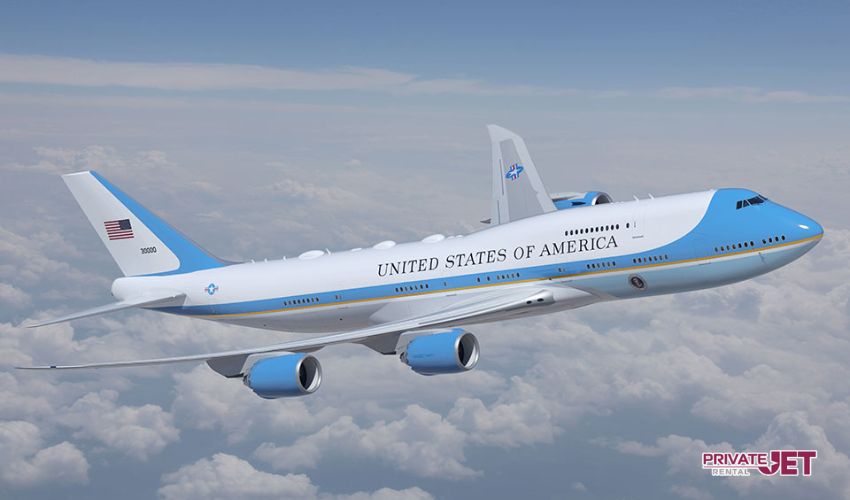
Why Fighter Jets Rarely Escort Air Force One
Hollywood movies always show fighter jets right next to the president’s wing. In reality, keeping tactical fighters next to a Boeing 747 creates massive logistical and safety problems. Military aviation planners avoid constant wingtip escorts for four practical reasons:
- Fuel and Range Limits: The VC-25A (the military Boeing 747) can fly 7,800 miles on one tank of fuel, slightly outlasting even the top civilian ultra-long-range jets and VIP airliners. Fighter jets like the F-16 or F-22 have short combat ranges and burn fuel fast. An escort group would need multiple aerial refueling tankers following them across the ocean.
- Wake Turbulence Risks: A heavy Boeing 747 creates violent, rotating air currents behind its wings. According to the FAA Pilot and Air Traffic Controller Guide to Wake Turbulence, these vortices sink 300 to 500 feet per minute, meaning escort pilots must stay strictly at or above the 747’s flight path to avoid hazardous air. Holding that precise formation for 10 hours causes extreme pilot fatigue.
- Foreign Airspace Laws: Flying armed U.S. combat jets into another country requires complex diplomatic clearance. Most allied nations forbid foreign armed fighters in their skies and provide their own air defense instead.
- Tactical Visibility: Fighters flying 100 feet away can’t stop a long-range surface-to-air missile. Modern air combat happens beyond visual range, often 50 to 100 miles away.
| Aircraft Metric | Air Force One (VC-25A) | Typical Escort (F-15E / F-22) | Operational Impact |
|---|---|---|---|
| Unrefueled Range | Approx. 7,800 miles | Approx. 1,200 to 2,000 miles | Fighters require constant tanker hookups on long trips. |
| Crew Endurance | 80+ crew beds & relief pilots | 1 to 2 strapped-in pilots | Fighter pilots can’t endure 10-hour nonstop flights safely. |
| Primary Defense | Electronic & laser jamming | Air-to-air missiles | Fighters can’t easily shoot down ground-fired heat-seeking missiles. |
3 Times Fighter Jets Actually Fly With the President
While routine flights do not have wingmen, you will see fighter jets next to the presidential plane in 3 specific situations.
National Emergencies (Such as 9/11)
During the September 11 attacks, the Secret Service and Air Force ordered armed F-16s to guard President George W. Bush’s plane as it flew from Florida to Louisiana and Nebraska. If unidentified aircraft violate restricted airspace near the president and ignore radio warnings, NORAD scrambles alert fighters to intercept the target immediately.
High-Risk and Combat Zones
When the president visits active conflict regions or flies near hostile borders, the U.S. military sets up a Combat Air Patrol (CAP). Passengers looking out the window still might not see them. Fighters like the F-15E Strike Eagle, F/A-18 Super Hornet, or F-35 fly miles ahead and above the Boeing 747 to clear the sky with powerful radars. For high-visibility deterrence in places like the Middle East, U.S. Central Command occasionally flies F/A-18s or bombers in visible formation to send a message to regional adversaries.
Foreign Ceremonial Welcomes
Most photos of fighter jets hugging the wings of Air Force One show foreign military planes, not American ones. Middle Eastern and European allies treat a fighter escort as a royal salute. For example, as reported by CBS News, 6 Egyptian Air Force jets flanked the president’s plane upon entering Egyptian airspace, continuing a ceremonial tradition also seen in Saudi Arabia, Qatar, and the UAE.
How Air Force One Protects Itself Without Fighter Jets
The presidential plane does not need a fighter escort because it has its own military defense network. Aviation experts at The Aviationist report that the VC-25A uses multi-layered electronic warfare systems to defeat surface-to-air and air-to-air missiles:
- AN/ALQ-204 Matador IRCM: This system is near the engines and shoots pulsed infrared light to blind heat-seeking missiles. Most aviation experts say the pod visible between the engines is the Matador module that stops missiles from locking onto engine exhaust.
- AN/AAR-54(V) Missile Warning Sensors: Mounted on the tail and fuselage, these ultraviolet sensors spot the exhaust plume of an incoming missile the second it launches from the ground.
- AN/AAQ-24 Nemesis (DIRCM): Once the warning sensors spot a threat, the Nemesis system aims a turret-mounted laser beam directly into the missile’s seeker head, confusing its guidance computer so it veers away.
- Chaff and Flares: The plane can shoot out clouds of metal foil (chaff) to confuse enemy radar and burning magnesium flares to trick heat-seeking weapons.
- EMP Shielding: The airframe holds 238 miles of heavy, shielded wiring. This protects the flight controls from an Electromagnetic Pulse (EMP) if a nuclear weapon detonates nearby.
The 2026 Interim Jet Controversy
These built-in defenses are so vital that the Secret Service refuses to fly the president into danger zones without them. As reported by The New York Times and defense analysts at Forecast International, the Secret Service forced a last-minute plane swap during the July 2026 NATO summit in Turkey.
An interim Boeing 747-8 acquired from Qatar had to be left behind due to security risks near Iranian airspace because it lacked the Large Aircraft Infrared Countermeasures (LAIRCM) system, forcing the president to fly home on the older VC-25A.
Follow-up reporting on the rushed L3Harris retrofit and ongoing missile defense upgrade delays proves you can’t quickly bolt classified defense networks onto a standard airliner; engineers must wire them deep into the airframe and power grid.
The Invisible Support Fleet Behind Every Trip
Even though fighter jets do not fly on the wing, the president never travels alone. Every major trip involves a coordinated support fleet and ground-based protection ring:
- C-17 Globemaster III Cargo Planes: Heavy military cargo planes fly ahead of the president to deliver the bulletproof “Beast” limousines, Secret Service tactical vehicles, and Marine One helicopters before the main plane lands.
- The E-4B Doomsday Plane: The National Airborne Operations Center (a modified Boeing 747) trails the president on international trips. It acts as a flying Pentagon and nuclear command bunker in case an emergency strikes while the president is overseas.
- Ground-Based Strip Alert: Instead of wasting fuel in the air, NORAD keeps armed fighter jets sitting on runways along the president’s flight path. These jets sit on “strip alert,” fueled, armed, and ready to take off in under 5 minutes if a threat appears on radar.
- 30-Nautical-Mile TFRs: The FAA places a strict Temporary Flight Restriction (TFR) around the president’s location. Any civilian pilot who wanders into this 30-mile ring faces immediate interception by alert fighters on standby.